The Rushurgent Working Group (RWG) began 2026 with a series of collaborative activities, field investigations, training initiatives, and research achievements that highlight its continued commitment to advancing geoscience research in the Philippines.
Inter-Agency Collaboration (January 6, 2026)
The year opened with an inter-agency seminar-workshop held at the University Hotel, bringing together researchers from NIGS and representatives from PHIVOLCS, MGB, and NAMRIA. Organized by the DOST-funded projects “Paleoseismology and Hazard Assessment of Seismogenic Sources in Northern Luzon” (PHASS) of Dr. Noelynna Ramos, Dr. Leo Armada and Dr. Carla Dimalanta and “Leveraging InSAR for Observation and Modeling of Earthquake Generators” (LiNOG) of Dr. John Dale Dianala, the event served as a venue for sharing techniques in fault mapping, geodesy, and geohazard evaluation, while strengthening coordination among institutions involved in national hazard assessment.
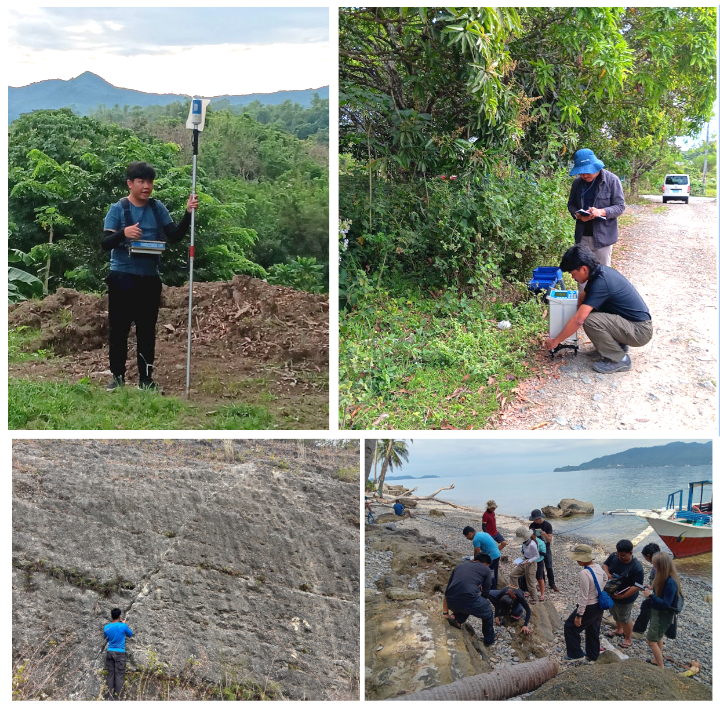
Geophysical Surveys and Geologic Mapping in Batangas (January 9–14, 2026)
Researchers from the DOST projects “3D Geophysical Mapping of the Southern Luzon Arc Crust and Geohazard Implications” (ARC3D), led by Dr. Carla Dimalanta, and “Seismic Scanning of Active Philippine Fault Splays for Marine Geohazards” (SeiScan), led by Dr. Leo Armada, conducted gravity and magnetic surveys in Batangas to acquire new geophysical data. Geologic mapping with several NIGS students was simultaneously carried out under the supervision of Dr. Gabriel Theophilus Valera and Dr. Betchaida Payot. These integrated datasets will support ongoing efforts to delineate faults and other subsurface structures in Southern Luzon.
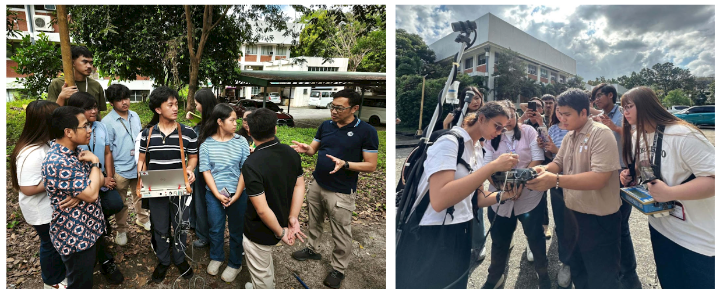
Hands-on Geophysics Training (February 21, 2026)
RWG researchers also hosted a hands-on geophysics session at NIGS for third-year students from Mapúa University. This consisted of demonstrations of the electrical resistivity (ER) meter, ground penetrating radar (GPR), magnetometers, and paleomagnetism equipment to provide practical insights into field investigations.
Seismic talk at the ABRASAHAN Webinars (March 7, 2026)
Dr. Leo T. Armada was one of the featured speakers in the ABRASAHAN webinar series, organized by the Engineering Mathematics and Science Society (EMSS) of Camarines Sur Polytechnic Colleges for junior and senior high school students. His talk, "Seeing the Invisible: How We Take Snapshots of the Earth's Interior Using Seismic Imaging," provided the participants with insights into how geophysicists “see” deep inside the Earth.

Research Publications
RWG researchers also reached publication milestones this quarter:
- From spreading to subduction: Timelines of induced subduction zones recorded in the Central Palawan Ophiolite. G.T.V. Valera, B.D. Payot, T. Kawakami, S. Sakata, S. Niki, & T. Hirata. Lithos, 108346. (https://doi.org/10.1016/j.lithos.2025.108346)
- Ba isotope unmasks recycling processes of fluid mobile elements in subduction zones. Y. Yu, X.L. Huang, B.D. Payot, H.Q. Liu, Y.D. Jiang, Y. Wang, C.B. Dimalanta, X.F. Ou, G.T.V. Valera, F. Yang, G.P. Yumul Jr., Y. Xu & X.H. Tang. Geochimica et Cosmochimica Acta. (https://doi.org/10.1016/j.gca.2026.01.038)
- Assessment of groundwater potential in North-Central Palawan using remote sensing and geophysical analysis of fractured basement aquifers. J.G. Cuevas, J.E. Cari, J.A. Principe, A.M. Tamondong, C.B. Dimalanta & L.T. Armada. ISPRS Annals of the Photogrammetry, Remote Sensing and Spatial Information Sciences, X-5/W4-2025, 197–203. (https://doi.org/10.5194/isprs-annals-X-5-W4-2025-197-2026)
Together, these activities reflect RWG’s continued efforts to strengthen research, collaboration, and training in geosciences.