Participating students in the fieldwork. Top row (left to right): Audric Gardoña, Kirsty Camba, Francesca Petero, Nathan Marquez (undergraduate student), and Jyll Botardo. Bottom row (left to right): Toby Vergara, Raphael Dequilla, and Miguel Villanueva.
Last March 2-12, 2026, six (6) graduate students and one (1) undergraduate student of the Nannoworks Laboratory conducted fieldwork in the province of La Union for their Geology 215 (Advanced Field Geology) and Geology 200 (Undergraduate Thesis) classes, respectively. Under the guidance of Dr. Allan Gil Fernando and the support of Toby L. Vergara (URA), the team performed detailed stratigraphic logging and collected both rock and fossil samples from outcrops of sedimentary formations, particularly the Late Pliocene Cataguintingan Formation, which is the main focus of the Geology 215 students’ research. The main goal of the fieldwork was to characterize the lithological and paleontological characteristics of the different facies of the Late Pliocene Cataguintingan Formation, with the students’ special research topics focusing on fossils such as calcareous nannoplankton, foraminifera, plant leaves, molluscans, and brachyuran crustaceans.
From March 3-4, 2026, the team worked inside the Helix Mining and Development Corporation’s (HMDC) quarry site in Bacnotan-Balaoan, La Union. This quarry contains outcrops of a paleochannel deposit that cuts through the Pleistocene Bacnotan Limestone. Notably, fossils of vertebrate animals, particularly bovids and cervids, have been periodically collected over the years since Dr. Fernando first discovered some remains in 1999. The highlight of this visit was the discovery and collection of a partial posterior fragment of a deer cranium with the right antler still attached. This is especially remarkable because this is both the first skull fossil and the largest fossil overall collected from the quarry to date.
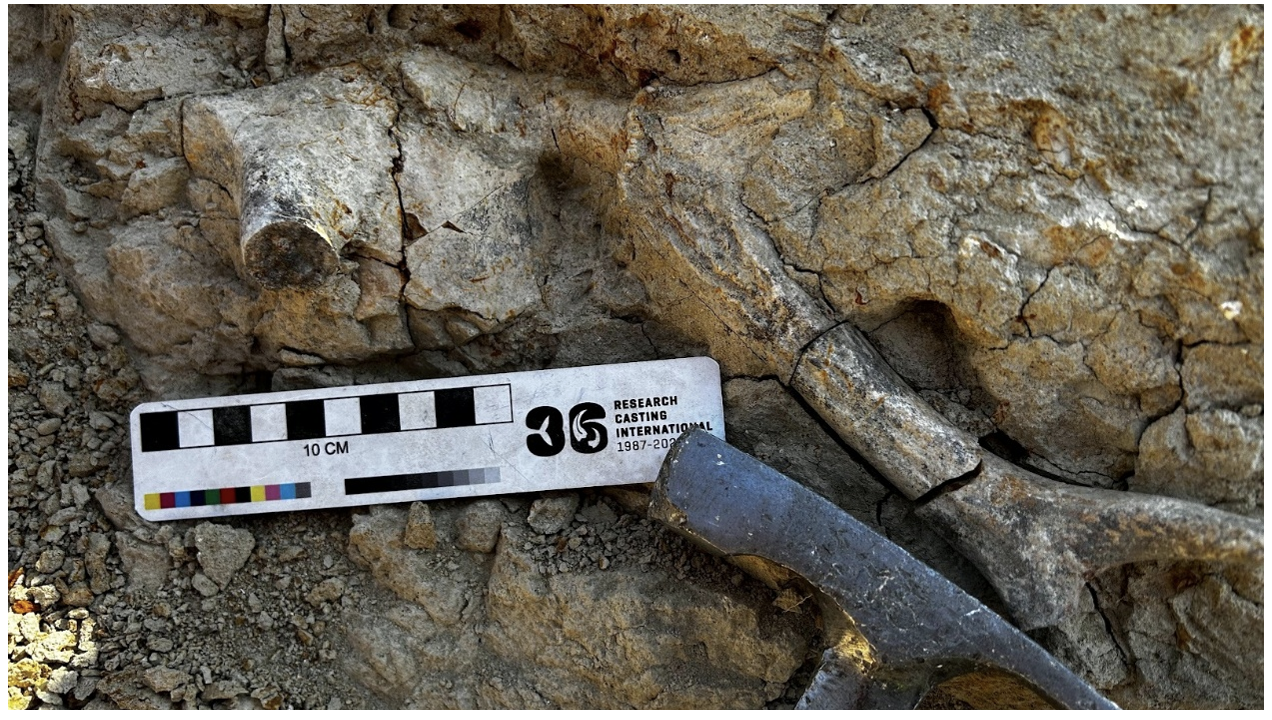
Deer skull fragment with antler in-situ in the paleochannel deposit within the HMDC quarry.
During the fieldwork, the class visited exposures of the Cataguintingan Formation in the municipalities of Balaoan, Bacnotan, San Juan, Bauang, Naguilian, Caba, Aringay, Agoo, Tubao, Pugo Santo Tomas, and Rosario. Detailed stratigraphic logging of the outcrops ws conducted, and the class recorded various sequences of clastic sedimentary rocks such as conglomerates, sandstones, and mudstones.
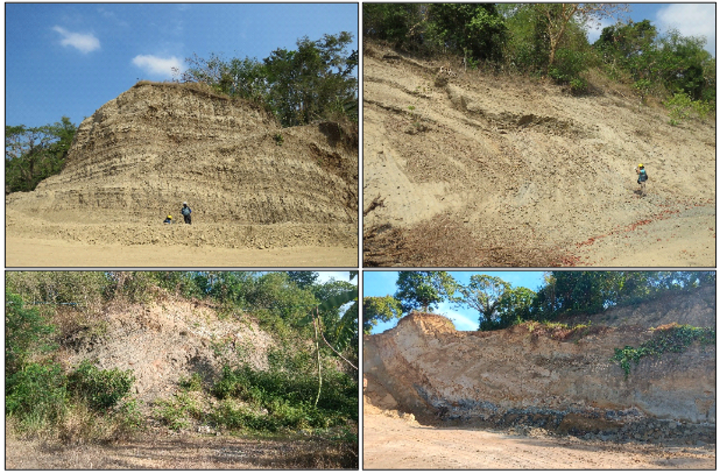
Rock formation exposures visited in municipalities of La Union province. From top to right: Bacnotan, Bauang, Tubao, and Santo Tomas.
Numerous fossil-bearing outcrops were also visited in La Union. Notable fossil sites include the following: (1) a paleochannel deposit in the HMDC Quarry, Bacnotan-Balaoan bearing vertebrate fossils and petrified wood, (2) a mudstone-sandstone sequence in Brgy. Cupang, Santo Tomas containing coal layers and abundant leaf fossils, and (3) mudstone beds in Forest Lake Cemetery, Brgy. Santiago, Bauang rich in well-preserved gastropod, pelecypod, and crustacean fossils
The rock and fossil samples shall undergo thorough petrographic and paleontological analyses in order to provide insight into the depositional history and paleoenvironment/s of the Cataguintingan Formation, as well as elucidate its stratigraphic relationships with the Amlang Formation, Damortis Formation, and Bacnotan Limestone, all within the Ilocos-Central Luzon Basin.