From September to October 2026, the Nannoworks Laboratory, in partnership with the Paleontological Society of the Philippines, invited alumni and affiliates as speakers for three installments of the NIGS Lecture Series.
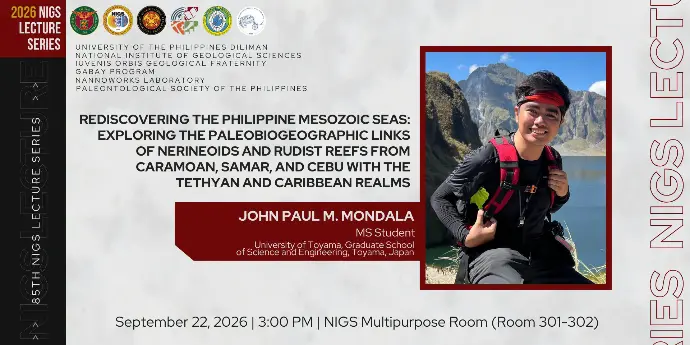
Official publicity material for the 85th NIGS Lecture Series by the Iuvenis Orbis Geological Fraternity.
The 85th installment was held last 22 September 2026 and featured Mr. John Paul (JP) M. Mondala, who delivered a talk entitled "Rediscovering the Philippine Mesozoic Seas: Exploring the Paleobiogeographic Links of Nerineoids and Rudist Reefs from Caramoan, Samar, and Cebu with the Tethyan and Caribbean Realms." His talk highlighted newly discovered Philippine fossil assemblages of rudist bivalves and nerineoidean gastropods, which offer fresh insights into the Cretaceous reef communities of the Philippines and the paleobiogeography of ancient tropical marine ecosystems in the western Pacific. JP is currently a Master of Science student in Earth, Life, and Environmental Science at the University of Toyama, Japan. He earned his BS in Geology degree from UP Diliman, where he also previously served as a University Research Associate and Instructor. His graduate research focuses on Mesozoic nerineoid gastropods and polyconitid rudist bivalves from the Philippines, while his undergraduate research under the Nannoworks Laboratory examined molluscan fossil assemblages from an uplifted marine terrace in La Union.
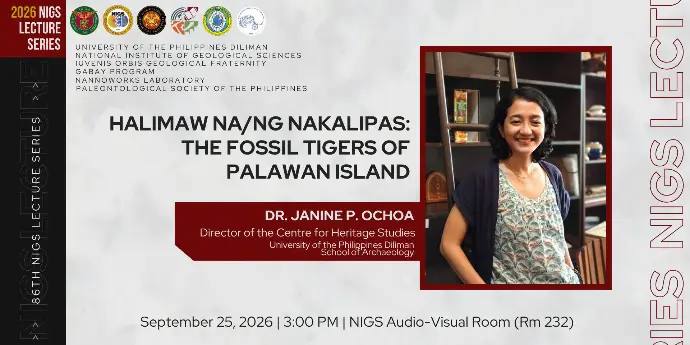
Official publicity materials for the 86th NIGS Lecture Series by the Iuvenis Orbis Geological Fraternity.
The 86th installment was held last 25 September 2026 and featured Dr. Janine P. Ochoa who delivered a talk on "Halimaw na/ng Nakalipas: The Fossil Tigers of Palawan Island." Her talk showcased the fossil remains of a large pantherine from Pilandok Cave which were attributed to the tiger (Panthera tigris; harimau/halimaw). These finds are a significant addition to the limited Late Pleistocene fossil inventory of large mammals in the archipelago and support the past existence of the Sunda tiger on the island of Palawan during the Late Pleistocene. Dr. Ochoa is an archaeologist and Associate Professor at the UP School of Archaeology, where she also serve as the Director of the Centre for Heritage Studies. Her current research interests include zooarchaeology, plurispecies engagements, terrestrial vertebrate biodiversity, collaborative archaeologies, and indigenous ecological knowledge systems.
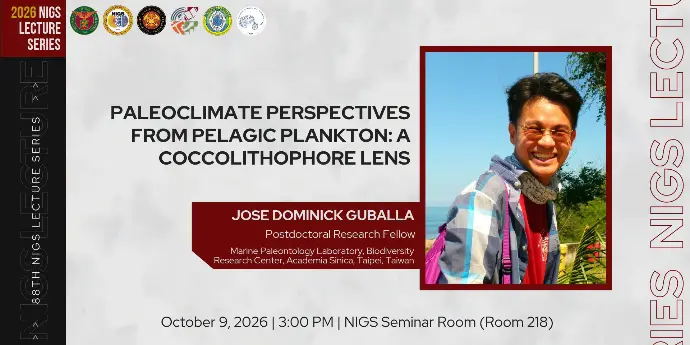
Official publicity materials for the 88th NIGS Lecture Series by the Iuvenis Orbis Geological Fraternity.
The 88th installment was held last 09 October 2026 and featured Dr. Jose Dominick S. Guballa, who delivered a talk entitled “Paleoclimate Perspectives from Pelagic Plankton: A Coccolithophore Lens.” His talk explored current research on how coccolithophores, a group of calcifying marine phytoplankton, may have responded to various drivers such as subaerial volcanism, abrupt climate change, and orbital forcing. These studies underscore the need to investigate the key factors driving past microplankton assemblage changes and their implications on interactions between solid Earth, climate, and the biosphere. Dr. Guballa obtained his BS and MS in Geology degrees from UP Diliman, where he also previously served as an Instructor. He obtained his PhD at the University of Toronto, Canada, and is currently a Postdoctoral Research Fellow at the Marine Paleontology Laboratory, Biodiversity Research Center, Academia Sinica, Taiwan.
These events were organized in partnership with the National Institute of Geological Sciences, the NIGS GABAY Program, and the Iuvenis Orbis Geological Fraternity.